
Used Trucks Charles Town WV: What to Check Before You Buy
A used truck can look ready for work or weekend hauling and still hide problems underneath. If you’re comparing used trucks Charles Town WV shoppers can find around Jefferson County and the Eastern Panhandle, a careful inspection can help you separate normal wear from warning signs before you commit.
Use this checklist to assess the truck’s condition, test how it drives, and ask questions that clarify its history and capabilities. You don’t need to be a mechanic; you do need enough time to look closely and, when appropriate, arrange an independent inspection.
Key takeaways
- Check the truck’s frame, underbody, tires, and signs of leaks before focusing on appearance or accessories.
- Start the engine cold, test the transmission and brakes, and drive on more than one type of road if possible.
- Match the truck’s towing and payload ratings to your actual needs; engine size alone does not tell the whole story.
- Ask for maintenance and ownership records, and consider a pre-purchase inspection if you want an independent mechanical assessment.
- Compare the total cost of ownership, including tires, fuel, repairs, and any modifications—not just the asking price.
Start underneath: frame, rust, leaks, and past repairs
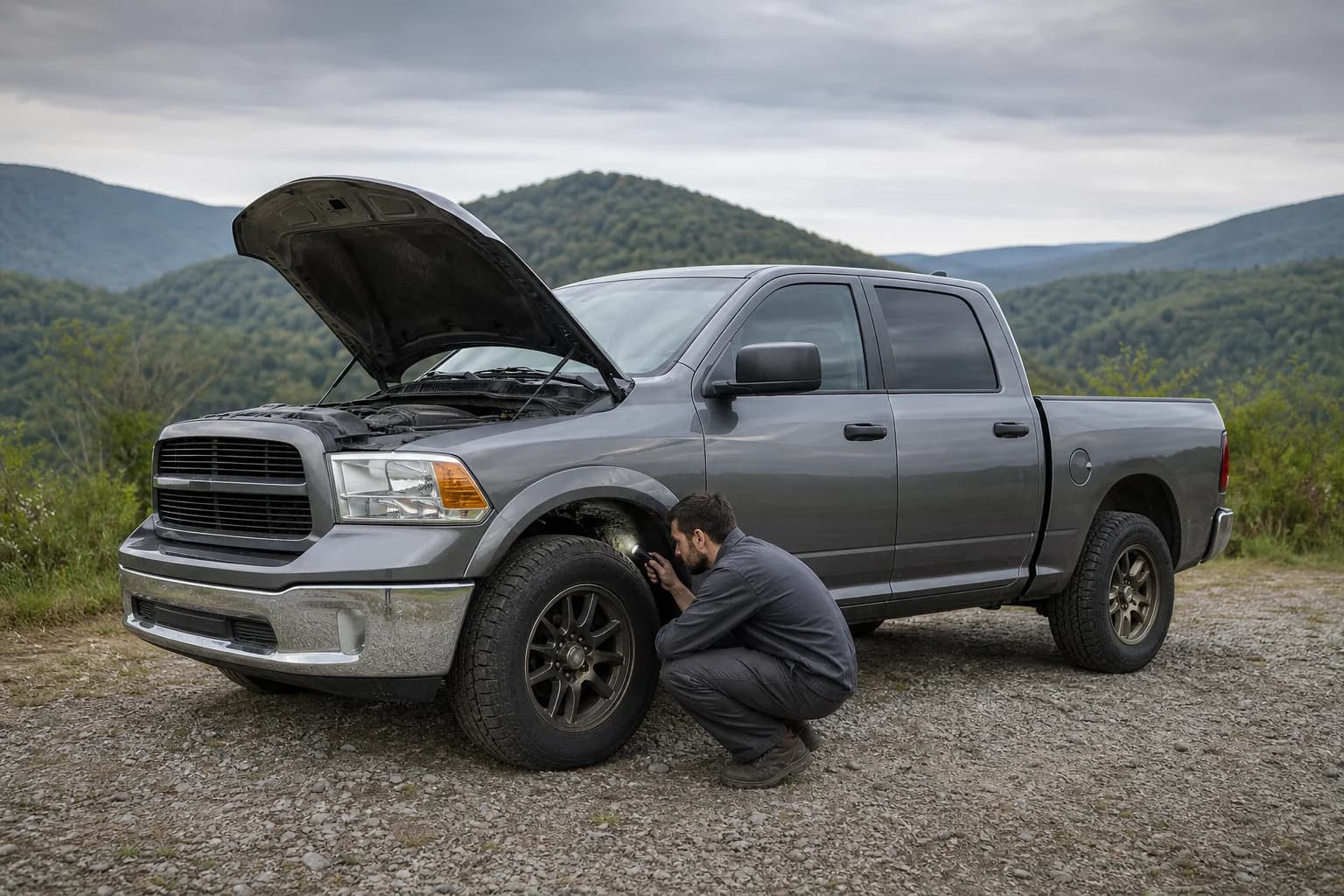
On a pickup, the underside often tells you more than a freshly cleaned exterior. Look at the frame rails, crossmembers, suspension mounting points, and bed supports for heavy corrosion, bent sections, cracked welds, or repairs that appear inconsistent. Surface discoloration can be ordinary; flaking scale, perforation, or damage near structural areas deserves closer attention.
Check for fresh fluid spots and wet areas around the engine, transmission, transfer case, differentials, and shocks. A small amount of grime does not prove a leak, but active drips or fluid spread across several components should be investigated. If the truck has four-wheel drive, inspect the front axle and transfer-case area as well as the rear drivetrain.
Look for evidence of hard use or poorly completed work: a bent hitch, damaged bed, unevenly worn tires, mismatched body panels, or wiring that has been spliced for accessories. A truck that has hauled or towed is not automatically a bad choice. The key is whether its condition and maintenance make sense for that use.
For a closer mechanical review, ask whether an independent pre-purchase inspection is appropriate. A qualified technician can examine areas that are difficult to assess in a quick walk-around, though an inspection is not a guarantee against every future repair.
Use this used truck inspection checklist inside and out
Take your time and inspect the truck in daylight, preferably before it has been driven that day. A warm engine can make some cold-start symptoms harder to notice, while rain or a recently washed exterior can obscure paint and leak clues.
- Body and bed: Check panel gaps, paint differences, dents, tailgate operation, bed-floor damage, and signs of a bed liner hiding corrosion or repairs.
- Glass and lights: Look for cracks, moisture inside lamp housings, and working headlights, brake lights, turn signals, and reverse lights.
- Tires and wheels: Compare tread depth across all four tires. Uneven wear can point to alignment, suspension, inflation, or prior damage concerns. Confirm the tires are an appropriate size and type for the truck.
- Cabin controls: Test windows, locks, mirrors, seat adjustments, climate controls, infotainment, backup camera, and warning lights.
- Seats, pedals, and belts: Look for wear that seems inconsistent with the stated mileage, and make sure every seat belt latches and retracts.
- Under the hood: Look for damaged hoses, loose wiring, unusual residue, low fluid levels, or strong fuel or burning smells. Do not open a hot cooling system.
Turn the key to the on position before starting. Most dashboard warning lights should illuminate briefly as a system check; ask about any light that stays on or never appears. After starting, listen for persistent knocking, rattling, squealing, or rough running. A brief sound can have different causes, so avoid diagnosing a problem from noise alone.
For concerns involving engine performance, transmission behavior, or drivetrain noises, a shop can provide a more informed assessment than a parking-lot check. Renn Kirby Charles Town Auto lists engine, transmission, and drivetrain service for customers who need help evaluating those systems.
Take a test drive that checks more than acceleration
Good used truck test drive tips start before you leave the lot: ask whether you can drive the truck from a cold start, and confirm the route allows safe stops, turns, and steady-speed driving. Follow the seller’s rules and avoid testing the vehicle beyond normal road conditions.
- Start and idle: Notice how readily the engine starts and whether it idles smoothly. Check for warning lights, smoke, or unusual vibration.
- Accelerate gently: The transmission should shift without repeated slipping, harsh jolts, or unexplained delays. Some trucks feel different depending on load and drivetrain, so note symptoms rather than assuming a specific cause.
- Brake at a safe speed: The truck should slow predictably without pulling strongly to one side, grinding, or significant steering-wheel vibration.
- Drive over ordinary road surfaces: Listen for clunks or rattles and notice whether the truck tracks straight. A brief, safe route on a rougher surface may reveal suspension noise that smooth pavement does not.
- Test turns and parking: Check steering effort, turning behavior, mirrors, cameras, and visibility. If equipped with four-wheel drive, ask how the system should be operated and tested; do not engage it on unsuitable pavement.
- Recheck after the drive: Look beneath the truck for new drips and notice any new smells. Confirm the temperature gauge remains in its normal range.
Do not use a test drive to attempt towing, hard acceleration, or off-road testing without clear permission and safe conditions. A normal road drive can reveal useful symptoms, but it cannot confirm every component’s condition or towing readiness.
Match the truck’s capability to your real needs
Before comparing engine options or trim packages, write down what the truck will actually do. Occasional home-improvement runs, regular trailer towing, and daily commuting place different demands on a pickup. The right choice is the one whose verified ratings and condition fit your use—not necessarily the largest or most powerful truck on the lot.
Check the manufacturer’s labels and owner’s information for payload and towing limits. These ratings vary by configuration, cab, bed, drivetrain, equipment, and model year. A hitch rating or advertised maximum towing figure does not establish what a particular truck can safely tow in your setup; account for passengers, cargo, trailer tongue weight, and required equipment.
Ask whether the truck has a towing package, brake controller, upgraded cooling, or other equipment you need, and verify that the features are present and functioning. If it has a lift or oversized tires, ask who installed them and whether the changes affect ride, handling, clearance, or maintenance. Modified trucks can suit specific needs, but undocumented alterations may make future diagnosis or parts selection more complicated.
Shoppers comparing used trucks Eastern Panhandle WV options should also consider daily driving and ownership costs. A heavy-duty truck may be useful for frequent work, but it can bring a firmer ride and different fuel, tire, and maintenance costs than a light-duty pickup. Compare the truck’s intended job with the trade-offs you’ll live with every week.
Verify history, paperwork, and the full cost
Ask for available maintenance records, the number of keys, and information about previous use, repairs, and modifications. Records can help establish a service pattern, but gaps do not automatically prove neglect. Compare the vehicle identification number on the truck with the paperwork, and review the title and sale documents carefully before signing.
Ask direct, neutral questions: Has it been used for commercial work or towing? Were there collision repairs? Are any warning lights on? What recent maintenance has been completed? Specific answers and supporting records are more useful than a general assurance that the truck is in good shape.
Build a realistic budget beyond the purchase price. Consider insurance, fuel, registration, immediate maintenance, and the condition of wear items such as tires and brakes. If you plan to finance, understand the amount financed, loan term, and total repayment—not only the monthly payment. Renn Kirby Charles Town Auto provides information about financing options for shoppers reviewing how a purchase may fit their budget.
When you’re ready to compare available pickups, review the dealership’s used truck inventory. Inventory changes, so confirm a specific vehicle’s availability and details before making plans to visit.
Frequently asked questions
What should I check first when buying a used truck?
Start with the frame and underbody, then check for leaks, tire wear, warning lights, and signs of collision repair. These areas can reveal concerns that are easy to miss when attention goes straight to trim, accessories, or paint.
Should I get a pre-purchase inspection on a used truck?
An independent pre-purchase inspection is worth considering, especially if the truck will tow, has modifications, shows warning signs, or has limited service records. It can identify current concerns a visual check may miss, but it cannot predict every future failure.
How can I tell if a used truck has been used for towing?
Look for a hitch, trailer wiring, bed wear, and signs of heavy or uneven suspension wear, then ask the seller about its use and maintenance. These clues are not proof by themselves; records and a professional inspection can provide more context.
Is a higher-mileage used truck always a bad buy?
No. Mileage is only one part of the decision; maintenance, condition, use, and price matter too. A well-documented truck with more miles may be a better fit than a lower-mileage truck with unexplained wear or deferred repairs.
A careful inspection will not remove every uncertainty, but it can help you ask better questions and avoid buying on appearance alone. Take the time to review the truck’s condition, test it on a sensible route, verify that its capabilities match your needs, and consider an independent inspection before deciding which used truck is right for you in Charles Town or the Eastern Panhandle.