
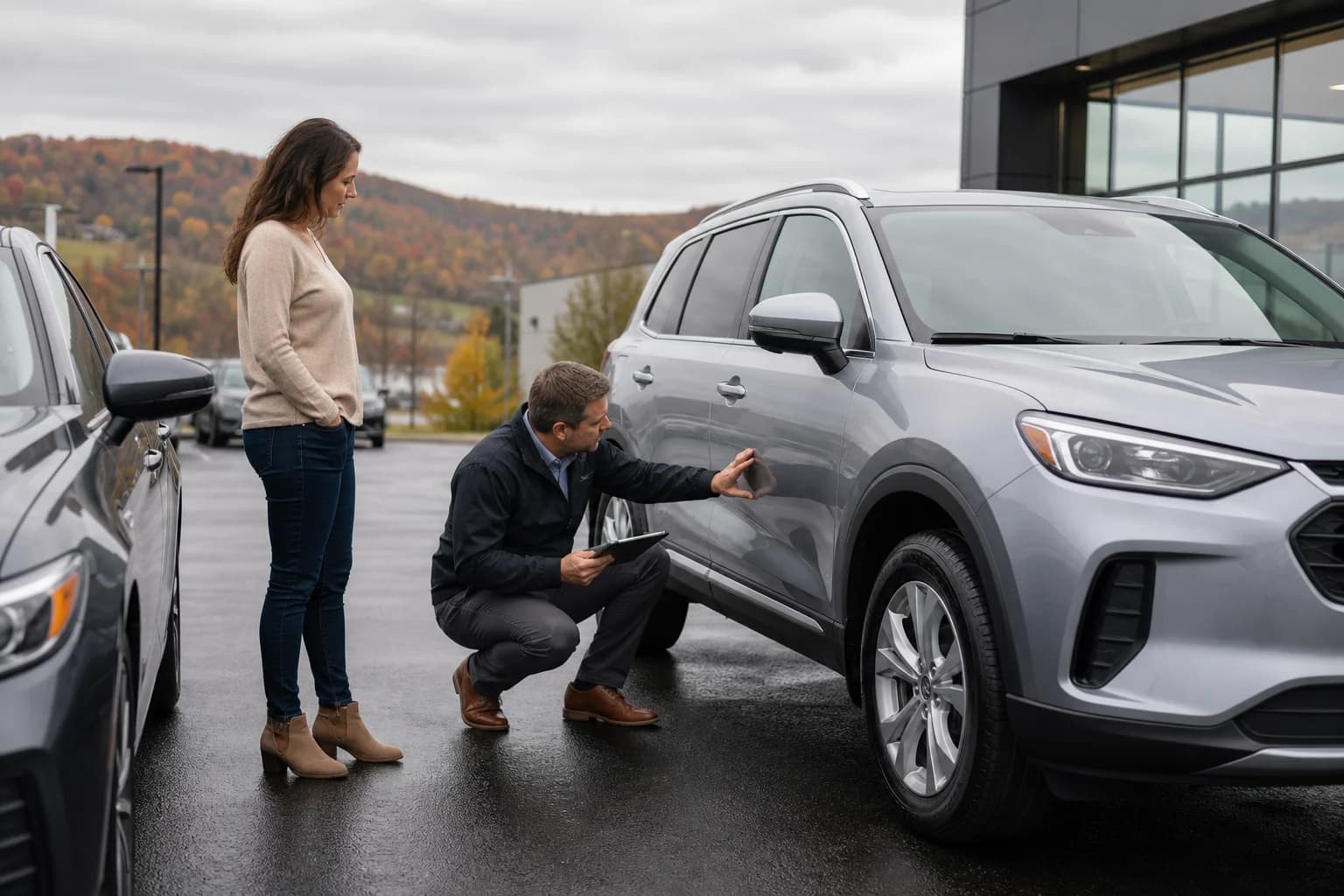
Trade-In Value Charles Town WV: Price Your SUV Swap
Trading your current vehicle toward a used SUV can make the switch simpler, but it is hard to judge an offer when online estimates, private-sale prices, and dealer appraisals do not match. To understand your trade-in value in Charles Town, WV, start with the vehicle’s condition, local market, and any loan balance—not just its year and mileage. This guide shows how to build a realistic value range, compare offers fairly, and plan a trade in a car for a used SUV around Charles Town and the Eastern Panhandle.
Key takeaways
- Use more than one pricing source to estimate a range; an online estimate is a starting point, not a guaranteed offer.
- Condition, mileage, title history, service records, and current demand all affect a used SUV trade-in in Charles Town.
- Compare the trade allowance, purchase price, fees, and loan payoff together—not as isolated numbers.
- Gather your title or lender information, registration, keys, and maintenance records before an appraisal.
- Get a written appraisal and ask what could change it before deciding whether to trade or sell privately.
How to value a car trade-in before you visit
A useful estimate is a range based on several sources, not one number copied from a valuation tool. Enter the exact year, make, model, trim, drivetrain, and mileage wherever possible. A base model and a higher trim can differ substantially, as can two vehicles with the same badge but different equipment or four-wheel-drive systems.
Check more than one reputable pricing guide, then compare the results with similar vehicles advertised for sale in the region. Remember that advertised retail prices are asking prices, not proof of what a vehicle ultimately sells for. A dealer’s trade offer also reflects reconditioning, inspection, inventory needs, and the cost of preparing the vehicle for resale.
Be precise about condition. If a tool asks whether the vehicle is in excellent, good, fair, or poor shape, read the definitions rather than choosing the most favorable label. A car with ordinary wear may be in good condition; worn tires, warning lights, significant body damage, or a mechanical issue can move it into a lower category.
- Identify the exact vehicle: Record trim, engine, drivetrain, options, and current odometer reading.
- Review the history: Note accidents, title status, prior use, and any unresolved recalls or warning lights.
- Document upkeep: Gather service receipts and describe recent repairs accurately.
- Compare like with like: Look at similar year, trim, mileage, and condition—not merely the same model name.
For a first estimate, you can use the dealership’s trade-in value tool. Treat any online figure as an estimate until the vehicle can be reviewed in person; details such as condition, equipment, and title status may affect the final appraisal.
What changes a used SUV trade-in offer in Charles Town?
Trade-in value is shaped by the vehicle itself and by what buyers are looking for. In Charles Town and nearby Jefferson County communities, shoppers may compare vehicles for commuting, family use, changing weather, and trips across the Eastern Panhandle. Those needs can make features such as all-wheel drive, four-wheel drive, cargo space, fuel economy, and safety equipment relevant—but demand varies by model and season.
Mileage matters, but it is not the whole story. A higher-mileage vehicle with consistent maintenance and clean documentation may present better than a lower-mileage vehicle with neglected service or an unresolved problem. A clean title and complete records can help clarify the vehicle’s history, while a branded title or reported damage may affect its marketability.
Condition is assessed across several areas, not just the paint. An appraiser may consider tire tread, brakes, glass, interior wear, warning lights, leaks, engine and transmission behavior, and whether important features work. A small cosmetic mark is different from a mechanical fault, and the likely cost and effort to address each issue can affect an offer.
Before spending money on repairs, ask whether the work is likely to improve the trade value enough to justify its cost. Replacing a safety-critical tire or fixing a simple issue may make sense; paying for a major repair solely to raise a trade offer may not. Keep receipts for work already completed, and disclose known problems rather than hoping they go unnoticed.
To compare the next vehicle against your budget, browse the dealership’s used SUVs available to view. Inventory changes, so compare the specific vehicle’s price, equipment, mileage, and condition with your needs rather than assuming every SUV is interchangeable.
Compare the whole deal, not just the trade allowance
A trade-in is one part of a vehicle purchase. The amount offered for your current car, the price of the SUV, taxes and fees, any loan payoff, and the financing terms all affect the final numbers. A higher trade allowance does not automatically mean a better deal if the replacement vehicle’s price or other costs are also higher.
Ask for the numbers in writing and review them separately. Compare the SUV’s selling price with similar vehicles, confirm the trade allowance, and check whether any optional products or fees are included. If you have a loan, request a current payoff amount from your lender; the balance shown on an older statement may not be exact on the day the transaction is completed.
If the payoff is lower than the trade allowance, the difference may contribute toward the next purchase, subject to the transaction details. If the payoff is higher, you have negative equity. That amount does not disappear when you trade; ask how it will be handled and what it means for the total amount financed and monthly payment.
Monthly payment alone can hide important differences. A longer loan term may lower the payment while increasing the time you owe money and potentially the total interest paid. Compare the amount financed, annual percentage rate, term, and any down payment—not just whether the payment fits a target.
Renn Kirby Charles Town Auto offers information about financing options for a vehicle purchase. Reviewing financing alongside your trade estimate can help you understand the full budget before choosing an SUV.
Prepare for an appraisal and decide whether to trade or sell
A little preparation makes an appraisal more straightforward. Remove personal belongings, bring the vehicle in reasonably clean, and make sure the appraiser can inspect it safely. A professional detail is rarely necessary; clear access to the interior, cargo area, and service records is more useful than an expensive cosmetic makeover.
- Bring your driver’s license and current registration.
- Bring the title if you own the vehicle outright, or lender and account details if it has a loan.
- Bring all keys and remotes, plus available service and repair records.
- Write down known issues, recent repairs, and any features that may not be obvious.
- Ask whether the appraisal is conditional and how long the offer is valid.
Trading at a dealership can be convenient: the appraisal and purchase can happen as part of one transaction, and you avoid arranging showings and payment with private buyers. A private sale may bring a different price, but it also takes time and requires you to manage inquiries, test drives, paperwork, and payment safely. The better route depends on your priorities, timeline, vehicle condition, and the actual numbers—not a blanket rule that one option always pays more.
When you receive an offer, ask what factors shaped it and whether it could change after a more detailed inspection. Share accurate information about the vehicle and ask for clarification if an adjustment is proposed. A clear explanation is more useful than negotiating around a number without understanding what it includes.
Frequently asked questions
How do I find my trade-in value in Charles Town, WV?
Start with the exact year, make, model, trim, mileage, and condition, then compare estimates from more than one pricing source. A local in-person appraisal can account for details an online form cannot verify, so treat estimates as a range rather than a guaranteed offer.
Should I fix my car before trading it in?
Not necessarily; compare the repair cost with the likely effect on the offer before authorizing work. Address safety issues when appropriate, keep records for completed repairs, and ask the appraiser how a known problem affects the vehicle’s value.
Can I trade in a car that still has a loan?
Yes, a vehicle with an outstanding loan can generally be considered for trade, but the lender’s payoff must be included in the transaction. Ask for a current payoff and compare it with the trade allowance so you know whether you have positive or negative equity.
Is a dealer trade-in better than selling privately?
It depends on the offer and how much time and effort you want to spend. A trade can simplify the purchase of your next SUV, while a private sale may suit someone willing to handle advertising, buyer questions, test drives, and payment arrangements.
Before you trade in a car for a used SUV, build a realistic value range, gather the vehicle’s records, and compare the complete purchase numbers—including any loan payoff. That approach helps you judge an offer on its merits and choose a vehicle that fits both your driving needs and budget in Charles Town and the Eastern Panhandle.